|
|
The Mausoleum of Halicarnassus
|
|
It was not only one of the wonders of
the ancient world:
We know from historians, the Mausoleum
was different - so different from the Pyramid that it earned its reputation - and a spot within the list - for
other reasons. Geographically, it is closer to the Temple of Artemis... And it was the beauty of the tomb rather
than its size that fascinated its visitors for years.
Like many other provinces, the kingdom of Caria in the western part of Asia Minor (Turkey) was so far from the
Persian capital that it was practically autonomous. From 377 to 353 BC, King Mausollos of Caria reigned in Mylasa
and moved his capital later to Halicarnassus. Nothing is exciting about Maussollos life except the construction
of his tomb. The project was conceived by his wife and sister Artemisia, and the construction might have started
during the king's lifetime. The Mausoleum was completed around 350 BC, three years after Maussollos death, and
one year after Artemisia's.
For 16 centuries, the Mausoleum remained in good condition until it tumbled in an heavy earthquake in 1304 AD.
In the early fifteenth century, the Knights of St John of Malta invaded the region and built a massive crusader
castle. When they decided to fortify it in 1494, they used the stones of the Mausoleum. By 1522, almost every block
of the Mausoleum had been disassembled and used for construction.
|
One of the knights named
La Touret describes the plundering of the tomb in his memoires, saying:
"First we found the stairs leading down to the burial chamber below the ground and we were breathless at the
spectacular sight in front of our eyes. The second minute we started looting the place, but we didnt have much
time, because they commanded us back to the castle. The next day when we came back to the same site, precious gold
jewelry and pieces of fine cloth were scattered around the place ...."
|
The burial chamber still seen today ,
was most probably robbed much earlier than the theft by the Knights of Rhodes.
Today, the massive castle still stands in Bodrum, and the polished stone and marble blocks of the Mausoleum can
be spotted within the walls of the structure. Some of the sculptures survived and are today on display at the British
Museum in London. These include fragment of statues and many slabs of the frieze showing the battle between the
Greeks and the Amazons. At the site of the Mausoleum itself, only the foundation remains of the once magnificent
Wonder.
Description
The structure was rectangular in plan, with base dimensions of about 40 m (120 ft) by 30 m (100 ft). Overlying
the foundation was a stepped podium which sides were decorated with statues. The burial chamber and the sarcophagus
of white alabaster decorated with gold were located on the podium and surrounded by Ionic columns. The colonnade
supported a pyramid roof which was in turn decorated with statues. A statue of a chariot pulled by four horses
adorned the top of the tomb.
The total height of the Mausoleum was 45 m (140 ft). This is broken down into 20 m (60 ft) for the stepped podium,
12 m (38 ft) for the colonnade, 7 m (22 ft) for the pyramid, and 6 m (20 ft) for the chariot statue at the top.
The beauty of the Mausoleum is not only in the structure itself, but in the decorations and statues that adorned
the outside at different levels on the podium and the roof. These were tens of life-size as well as under and over
life-size free-standing statues of people, lions, horses, and other animals. The statues were carved by four Greek
sculptors: Bryaxis, Leochares, Scopas, and Timotheus, each responsible for one side. Because the statues were of
people and animals, the Mausoleum holds a special place in history as it was not dedicated to the gods of Ancient
Greece.
Since the nineteenth century, archeological excavations have been undertaken at the Mausoleum site. These excavations
together with detailed descriptions by ancient historians give us a fairly good idea about the shape and appearance
of the Mausoleum. A modern reconstruction of the shorter side of the Mausoleum illustrates the lavish nature of
the art and architecture of the building... a building for a King whose name is celebrated in all large tombs today
-- mausoleums.
The Mausoleum finally was destroyed by an earthquake in 1304 AD
Torba, a modern village with holiday
villas and a nice marina is located 8 km north of Bodrum. Gölköy and Türkbükü are small
and simple fishing villages with a
handful of
Artemisia II
|

|
|
|
|
|
|
Artemisia II, statue by an unknown artist; in the National Archeological Mu ...
|
|
|
|
|
sister
and wife of King Mausolus
(reigned 377/376-353/352) of Caria, in southwestern Anatolia, and sole ruler for about three years after the king's
death. She built for her husband, in his capital at Halicarnassus
(modern Bodrum, Turkey), the tomb called the Mausoleum, which was considered one of the Seven Wonders of the World.
Artemisia was also known as a botanist and medical researcher; Artemisia, a plant genus, is named after her.
taverns overlooking a lovely bay.
|
|
|
|
|

|
|
Engraving of Mausoleum at Helicarnassus
Fischer von Erlach is regarded as Austria's greatest Baroque architect. This drawing
is from his book "Entwurff einer historischen Architektur" (1721), a comparative history of architecture
from ancient Roman through to his own Baroque style.
© Historical Picture Archive/CORBIS
Image ID: HT007250
|
|
|
|
|
Click
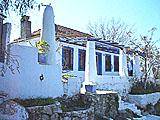
to enlarge This is the kind of houses
making big city people coming down to the Bodrum peninsula.

|
|
|
|
|
|
Click
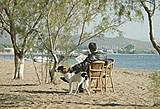
to enlarge wide and sandy beaches in
Ortakent/Yahsi
|
|
|
|
|
|
A summer evening
in
Türkbükü click
to enlarge


|
|
|
|
|
|
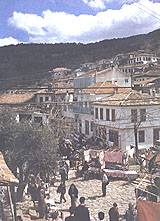
Traditional life
lingers on
in Mumcular
|
|
|
|
|
|
Halicarnassus, Mausoleum of
Britannica
|
|
|
|

|
|
|
|
|
|
Battle between Greeks and Amazons, section of marble frieze from the Mausol ...
|
|
|
|
|
one
of the Seven Wonders of the World. The monument was the tomb of Mausolus, the tyrant of Caria in southwestern Asia
Minor, and was built between about 353 and 351 BC by Mausolus' sister and widow, Artemisia. The architect was Pythius
(or Pytheos), and the sculptures that adorned the building were the work of four leading Greek artists: Scopas,
Bryaxis, Leochares, and Timotheus.
According
to the description of the Roman author Pliny the Elder (ad 23-79), the monument was almost square,
with a total periphery of 411 feet (125 m). It was bounded by 36 columns, and the top formed a 24-step pyramid
surmounted by a four-horse marble chariot. Fragments of the mausoleum's sculpture that are preserved in the British
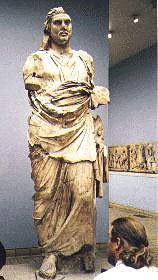
Museum include a frieze of battling Greeks and Amazons and a statue 10 feet (3 m) long, probably of Mausolus. The
mausoleum was probably destroyed by an earthquake between the 11th and the 15th century AD, and the stones were
reused in local buildings.
I have lying, over me in Halicarnassus, a gigantic monument such as no other dead person has,
adorned in the finest way with statues of horses and men carved most realistically from the best quality marble.
King Maussollos
in Lucian's "Dialogues of the Dead"
.gif)
Note: The color painting at the top of the page is of artistic nature and does not necessarily represent an
accurate reconstruction of the Wonder. Painting by Mario Larrinaga.
Similar to the Great Pyramid, we are now visiting
the burial place of an ancient king. Yet the Mausoleum is different - so different from the Pyramid that it earned
its reputation - and a spot within the list - for other reasons. Geographically, it is closer to the Temple
of Artemis... And it was the beauty of the tomb rather than its size that fascinated its visitors for years.
Location
In the city of Bodrum (f.k.a. Halicarnassus) on the Aegean
Sea, in south-west Turkey.
History
When the Persians expanded their ancient
kingdom to include Mesopotamia, Northern India, Syria, Egypt, and Asia Minor, the king could not control his vast
empire without the help of local governors or rulers -- the Satraps. Like many other provinces, the kingdom of
Caria in the western part of Asia Minor (Turkey) was so far from the Persian capital that it was practically autonomous.
From 377 to 353 BC, king Mausollos of Caria reigned and moved his capital to Halicarnassus. Nothing is exciting
about Maussollos life except the construction of his tomb. The project was conceived by his wife and sister Artemisia,
and the construction might have started during the king's lifetime. The Mausoleum was completed around 350 BC,
three years after Maussollos death, and one year after Artemisia's.
For 16 centuries, the Mausoleum remained in good condition until an earthquake caused some damage to the roof
and colonnade. In the early fifteenth century, the Knights
of St John of Malta invaded the region and built a massive
crusader castle. When they decided to fortify it in 1494, they used the stones of the Mausoleum. By 1522, almost
every block of the Mausoleum had been disassembled and used for construction.
Today, the massive castle still stands in
Bodrum, and the polished stone and marble blocks of the Mausoleum can be spotted within the walls of the structure.
Some of the sculptures survived and are today on display at the British
Museum in London. These include fragment of statues and many slabs of the frieze showing the battle between
the Greeks and the Amazons. At the site of the Mausoleum itself, only the foundation remains of the once magnificent
Wonder.
Description
The structure was rectangular in plan, with base dimensions of about 40 m (120 ft) by 30 m (100 ft). Overlying
the foundation was a stepped podium which sides were decorated with statues. The burial chamber and the sarcophagus
of white alabaster decorated with gold were located on the podium and surrounded by Ionic columns. The colonnade
supported a pyramid roof which was in turn decorated with statues. A statue of a chariot pulled by four horses
adorned the top of the tomb.
The total height of the Mausoleum was 45 m (140 ft). This is broken down into 20 m (60 ft) for the stepped podium,
12 m (38 ft) for the colonnade, 7 m (22 ft) for the pyramid, and 6 m (20 ft) for the chariot statue at the top.
The beauty of the Mausoleum is not only in the structure itself, but in the decorations and statues that adorned
the outside at different levels on the podium and the roof. These were tens of life-size as well as under and over
life-size free-standing statues of people, lions, horses, and other animals. The statues were carved by four Greek
sculptors: Bryaxis, Leochares, Scopas, and Timotheus, each responsible for one side. Because the statues were of
people and animals, the Mausoleum holds a special place in history as it was not dedicated to the gods of Ancient
Greece.
Since the nineteenth century, archeological excavations have been undertaken at the Mausoleum site. These excavations
together with detailed descriptions by ancient historians give us a fairly good idea about the shape and appearance
of the Mausoleum. A modern reconstruction of
the shorter side of the Mausoleum illustrates the lavish nature of the art and architecture of the building...
a building for a King whose name is celebrated in all large tombs today -- mausoleums.
The Mausoleum at Halicarnassus
Copyright Lee Krystek, 1998  
In 377 B.C., the city of Halicarnassus was the capitol of a small kingdom along the Mediterranean coast of Asia
Minor. It was in that year the ruler of this land, Hecatomnus of Mylasa, died and left control of the kingdom to
his son, Mausolus. Hecatomnus, a local satrap to the Persians, had been ambitious and had taken control of several
of the neighboring cities and districts. Mausolus in his time, extended the territory even further so that it finally
included most of southwestern Asia Minor.
Mausolus, with his queen Artemisia, ruled over Halicarnassus and the surrounding territory for 24 years. Mausolus,
though he was descended from the local people, spoke Greek and admired the Greek way of life and government. He
founded many cities of Greek design along the coast and encouraged Greek democratic traditions.
Then in 353 B.C. Mausolus died, leaving his queen Artemisia, who was also his sister (It was the custom in Caria
for rulers to marry their own sisters), broken-hearted. As a tribute to him, she decided to build him the most
splendid tomb in the known world. It became a structure so famous that Mausolus's name is now associated with all
stately tombs through our modern word mausoleum. The building was also so beautiful and unique it became one of
the Seven Wonders of the Ancient World.
Artemisia decided that no expense was to be spared in the building of the tomb. She sent messengers to Greece
to find the most talented artists of the time. This included Scopas, the man who had supervised the rebuilding
of the Temple to Artemis at Ephesus. Other famous sculptors
such as Bryaxis, Leochares and Timotheus joined him as well as hundreds of other craftsmen.
The tomb was erected on a hill overlooking the city. The whole structure sat in an enclosed courtyard. At the
center of the courtyard was a stone platform on which the tomb itself sat. A staircase, flanked by stone lions,
led to the top of this platform. Along the outer wall of this were many statues depicting gods and goddess. At
each corner stone warriors, mounted on horseback, guarded the tomb.
At the center of the platform was the tomb itself. Made mostly of marble, the structure rose as a square, tapering
block to about one-third of the Mausoleum's 140 foot height. This section was covered with relief sculpture showing
action scenes from Greek myth/history. One part showed the battle of the Centaurs with the Lapiths. Another depicted
Greeks in combat with the Amazons, a race of warrior women.
On top of this section of the tomb thirty-six slim columns, nine per side, rose for another third of the height.
Standing in between each column was another statue. Behind the columns was a solid block that carried the weight
of the tomb's massive roof.
The roof, which comprised most of the final third of the height, was in the form of a stepped pyramid. Perched
on top was the tomb's penultimate work of sculpture: Four massive horses pulling a chariot in which images of Mausolus
and Artemisia rode.
Soon after construction of the tomb started Artemisia found herself in a crisis. Rhodes, an island in the Aegean
Sea between Greece and Asia Minor, had been conquered by Mausolus. When the Rhodians heard of his death they rebelled
and sent a fleet of ships to capture the city of Halicarnassus. Knowing that the Rhodian fleet was on the way,
Artemisa hid her own ships at a secret location at the east end of the city's harbor. After troops from the Rhodian
fleet disembarked to attack, Artemisia's fleet made a surprise raid, captured the Rhodian fleet, and towed it out
to sea.
Artemisa put her own soldiers on the invading ships and sailed them back to Rhodes. Fooled into thinking that
the returning ships were their own victorious navy, the Rhodians failed to put up a defense and the city was easily
captured quelling the rebellion.
Artemisa lived for only two years after the death of her husband. Both would be buried in the yet unfinished
tomb. According to the historian Pliny, the craftsmen decided to stay and finish the work after their patron died
"considering that it was at once a memorial of their own fame and of the sculptor's art."
The Mausoleum overlooked the city of Halicarnassus for many centuries. It was untouched when the city fell to
Alexander the Great in 334 B.C. and still undamaged after attacks by pirates in 62 and 58 B.C.. It stood above
the city ruins for some 17 centuries. Then a series of earthquakes shattered the columns and sent the stone chariot
crashing to the ground. By 1404 A.D. only the very base of the Mausoleum was still recognizable.
Crusaders, who had occupied the city from the thirteen century onward, recycled the broken stone into their
own buildings. In 1522 rumors of a Turkish invasion caused Crusaders to strengthen the castle at Halicarnassus
(which was by then known as Bodrum) and much of the remaining portions of the tomb was broken up and used within
the castle walls. Indeed sections of polished marble from the tomb can still be seen there today.
At this time a party of knights entered the base of the monument and discovered the room containing a great
coffin. The party, deciding it was too late to open it that day, returned the next morning to find the tomb, and
any treasure it may have contained, plundered. The bodies of Mausolus and Artemisia were missing too. The Knights
claimed that Moslem villagers were responsible for the theft, but it is more likely that some of the Crusaders
themselves plundered the graves.
Before grounding much of the remaining sculpture of the Mausoleum into lime for plaster the Knights removed
several of the best works and mounted them in the Bodrum castle. There they stayed for three centuries. At that
time the British ambassador obtained several of the statutes from the castle, which now reside in the British Museum.
In 1846 the Museum sent the archaeologist Charles Thomas Newton to search for more remains of the Mausoleum.
He had a difficult job. He didn't know the exact location of the tomb and the cost of buying up all the small parcels
of land in the area to look for it would have been astronomical. Instead Newton studied the accounts of ancient
writers like Pliny to obtain the approximate size and location of the memorial, then bought a plot of land in the
most likely location. Digging down, Newton explored the surrounding area through tunnels he dug under the surrounding
plots. He was able to locate some walls, a staircase, and finally three of the corners of the foundation. With
this knowledge, Newton was able to figure out which plots of land he needed to buy.
Newton then excavated the site and found sections of the reliefs that decorated the wall of the building and
portions of the stepped roof. Also a broken stone chariot wheel, some seven feet in diameter, from the sculpture
on the roof was discovered. Finally, he found the statues of Mausolus and Artemisia that had stood at the pinnacle
of the building.
Today these works of art stand in the Mausoleum Room at the British Museum. There the images of Mausolus and
his queen forever watch over the few broken remains of the beautiful tomb she built for him.
 The
mausoleum of Halikarnassos (near Bodrum in modern day Turkey) is one of the ancient seven wonders in the world.
The monument was according to some sources still standing in the 12th century AD. The
mausoleum of Halikarnassos (near Bodrum in modern day Turkey) is one of the ancient seven wonders in the world.
The monument was according to some sources still standing in the 12th century AD.
Between 1856 and 1858 Sir Charles Newton and in 1865 G.M.A. Biliotti excavated the ancient ruins. An nowdays the
British Museum in London now houses some examples of sculpture and
relief's from the mausoleum. On the original site there is nothing left but ruins.
On this page I present my series of photographs of the frieze of the mausoleum which I have in the British Museum
taken in July 1999. All images contain a short description of the depicted scene.
The relief's depict a battle between the Amazons and the Greek and were sculpted around 350 BC by four different
artists.
For more information on the story behind the images see the link to the Perseus
Project below.
The frieze can be read like a cartoon, hence the title of this article. The scenes are dramatic and dynamic
The images on this page are displayed in the order that they are displayed in the British Museum. The names
refer to the inventory number of the British Museum. You can either click on of the links below or go to the site map to see thumbnail images of each
fotograph.
MAUSOLEUM AT HALICARNASSUS
F. Norman Pryce
1924
01391
B udrum is a small Turkish port, with a ruined castle of the Knights of St. John of Jerusalem, beautifully situated
on the coast of the Gulf of Kos at the south-west angle of Asia Minor. The district was known in ancient times
as Caria, and though nominally a province, or satrapy, of the great empire of Persia, its situation, shut of3!
between the mountains and the sea at the extreme limits of the empire, secured for it a measure of independence.
In the first half of the fourth century BCE the country was ruled by an active and warlike prince, Mausolus, who
fixed his capital on the site of Budrum, anciently called Halicarnassus.
On his death, in the year 353 BCE, his devoted widow, Artemisia, resolved to perpetuate his memory and appease
her own sorrow by erecting for him the most splendid tomb ever known, and sent to Greece to secure the services
of the most renowned artists of the age. The names of the architects were Satyros and Pythios. The sculptors who
were to adorn the structure were Scopas, the greatest Greek sculptor of the century—famed above all for his power
to express in stone the most passionate emotions and the most vivid movement—Timotheos, Bryaxis, and Leochares,
of whom less is now known, but who in their own age were considered second only to Scopas.
Queen Artemisia reigned for only two years, and then died, consumed by wasting grief for the loss of her husband.
The tomb was then still unfinished, but the artists resolved to complete it as a labour of love "for their
own fame and a record of their skill." The result was a work of such magnificence and splendour that it ranked
as one of the Seven Wonders of the World, and its name, the Mausoleum, has come generally to be employed to denote
any elaborate sepulchre. Descriptions of the building have been handed down to us by more than one ancient writer,
but, unfortunately, these are ambiguous and permit of interpretation in various ways, and the dimensions as recorded
are suspected by some authorities.
There is thus considerable difference of opinion with regard to many details of the Mausoleum, and a large number
of widely differing reconstructions have been produced. Generally speaking, however, the building was rectangular,
with the short sides on the north and south; the lower storey, in which was the tombchamber, was solid; bans of
sculpture ran round all four sides. Above this was a colonnade of thirty-six columns- of the Ionic order of rich
golden-white marble, which was surmounted by a pyramid of twenty-four steps, and on the top of the pyramid was
a chariot with four horses. The total height was one hundred and forty feet. What appeared to ancient sightseers
the most remarkable feature of the building was the impression of lightness; the massive pyramid, poised on top
of the slender colonnade, appeared to float in air. There is reason to believe that down to the twelfth century,
or even later, the building survived practically undamaged. But in 1402 the Knights of St. John took possession
of Halicarnassus and began to build on the site their castle of St. Peter.
To obtain the necessary building materials they pulled down the remains of the ancient city, and probably about
this time the superstructures of the Mausoleum were destroyed. In 1472 the building was in ruins, and the last
of these ruins was destroyed in 1522, when Sultan Suleiman was preparing his great expedition to drive the Knights
out of Asia Minor and Rhodes. The Grand Master of the Order of St. John, realising the military importance of the
castle at Budrum, ordered it to be put in repair. For this purpose the Knights broke up the base of the Mausoleum
and burnt the marble blocks for lime.
While doing this they broke into a large square chamber elaborately adorned with slabs and bands of marbles of
different colours, with battle scenes sculptured in relief. The story goes that the finders at first admired these,
and then broke them up. They then penetrated into an inner chamber containing a sarcophagus. As night was coming
on they returned to the castle, and in the morning when they returned they found that this tomb had been robbed
during the night by unknown pirates or brigands. Thus the grave of Mausolus, after remaining inviolate for over
eighteen centuries, was finally destroyed. Shortly afterwards the Knights of St. John were driven from Budrum by
the Turks, and all recollection even of the site was lost.
Although this wholesale destruction is recorded of the Knights, yet at times a desire seems to have prevailed to
preserve and save some fragments of the priceless sculptures which otherwise would have been fed to their lime-kilns.
At some unknown date a slab of carved frieze was sent to Genoa; other slabs were built into the walls of the castle
into which a number of marble lions were also inserted. In the seventeenth and eighteenth centuries Western travellers
and merchants passing through Budrum observed these fragments, and it was rightly concluded that they must have
been taken from the Mausoleum. In 1846 Lord Stratford de Redeliffe, then British Ambassador at Constantinople,
obtained permission of the Sultan to remove to the British Museum twelve slabs forming part of the large frieze
showing the combat of Greeks and Amazons. In 1856 Sir Charles Newton was allowed to remove the lions and also to
excavate on the actual site.
The excavation revealed little more than the foundations and ground plan, and it was evident that the Knights had
destroyed everything above ground. Scattered about in the vicinity of the site, however, were discovered a large
number of fragments of architecture and sculpture, which with great labour were brought to England and put together
in the Mausoleum Room of the British Museum.
The most striking of the sculptures thus recovered are the fragments of the chariot group which surmounted the
pyramid. The top step of the pyramid has been preserved, showing a horse's hoof in position. Large portions of
the colossal bodies of the marble horses, decked out with harness of gilded bronze still remain, and it is conjectured
that the two portrait statues of Mausolus and Queen Artemisia stood originally in the chariot, thus crowning the
whole edifice.
The portrait of Mausolus can be identified from his coins. It shows a bearded man, in the prime of life, richly
robed, and with an expression of quiet dignity. The head of the companion statue is injured, so the identification
as Artemisia, though extremely probable, is not certain; nor is it universally accepted that the statues did originally
stand in the chariot. Some authorities have preferred to suppose that they formed part of the groups of statuary
scattered about and within the building, of which numerous fragments have been found.
The other decorations of the Mausoleum take the form of three long bands of sculptured frieze which ran round the
building, though the level at which they were applied cannot be determined. It has, however, been observed that
the least important of the threc a frieze representing Greeks and Centaurs, of which very little remains - is less
carefully finished than the others. Probably, therefore, it was placed high up, at some distance from the spectator's
eye.
Of the other two friezes one is narrow and of very fineworkmanship, but it survives only in small fragments. The
subject is a chariot race. The third is the best preserved of all. Twelve complete slabs were taken out of the
walls of the castle in 1846; four additional slabs, the finest of all, and hundreds of fragments were discovered
during the excavations; and yet one other slab was obtained from a palace in Genoa in 1865. Thus pieced together,
the frieze occupies the whole length of the room in the British Museum.
As was the invariable custom with Greek architectural ornaments, the whole frieze was originally bright with colour:
blue background, red flesh, white, green, and gold drapery. The weapons of the combatants and harness of the horses
were of bronze, and the holes for this metal embellishment may be observed along the whole length. The figures
are slenderly proportioned and broadly spaced out against the background, which thereby gives due eSect to a certain
fondness for oblique lines which is visible in the pose of the figures, nearly all of which are either lunging
forward or drawing back with one leg straightened out down to the ground-line. The result is a wonderful spring
and movement beating rhythmically along the whole length of the frieze. Never has the rush of battle been rendered
with more vigour.
Sculptures


London, British Museum:
Loewen vom Mausoleum
At the very top of the tomb was a twenty-four-step pyramid surmounted by a marble chariot twenty-five feet tall.
The marble base contained a room in which both Mausolus, of whom the tomb was built for, and his wife Artemisia
were to be entombed. The Mausoleum had a perimeter of 411 feet (125 meters). It was built to be known for its beauty,
richness, and grace.

The Mausoleum of Halicarnassus was built in approximately 353 B.C.,
and it was said to be one of the finest buildings in all of Halicarnassus. The Mausoleum's construction was ordered
by Queen Artemisia to be a tomb and monument of King Mausolus. After his death, Queen Artemisia resolved to build
him the most immaculate tomb the world had ever seen. She sent for the most gifted artist of that time period.
Sculptors like Scopas who had helped rebuild the Temple of Artemis at Ephesus, and others such as Timotheus Bryaxis
and Leochares. The architects who answered Artemisia’s call were Satyros and Pythias. In building the tomb no effort
was made to out do the pyramids. Two years after her husband's death and the construction of the tomb began, Queen
Artemisa died. At this time the tomb was still incomplete, however the sculptors resolved to finish their work.
The tomb became known as the mausoleum, and the word has passed into our language, as a word used to describe a
large tomb. Earthquakes destroyed the Mausoleum in the fifteenth century, shattering the columns and sending the
chariot crashing down.
By 1404 AD only the square base remained intact, the rest of
the stone was used by the Crusaders for building material. It was the Crusaders who discovered what was in the
base of the monument, and it was during this time that a group of Crusaders ransacked the tomb stripping it of
all its treasure. In 1897 a British archeologist named Newton began to excavate the remains. He found fragments
of the chariot and uncovered statues of both Mausolos and Artemisia. The remains can be found in the Mausoleum
Room of the British Museum.
The Mausoleum
overlooked the city of Halicarnassus for
many centuries. It was untouched when the city fell to Alexander the Great in 334 B.C. and still undamaged after attacks by pirates in 62 and 58 B.C.. It stood above
the city ruins for some 17 centuries.
Then a series of earthquakes shattered the columns and sent the stone chariot crashing
to the ground. By 1404 A.D. only the very base of the Mausoleum was still recognizable. Crusaders, who had occupied the city from the thirteen century onward,
recycled the broken stone into their own buildings. In 1522 rumours of a Turkish invasion caused Crusaders to strengthen
the castle at Halicarnassus (which was
by then known as Bodrum) and much of the
remaining portions of the tomb was broken up and used within the castle walls. Indeed sections of polished marble
from the tomb can still be seen there today.
In 1846 the Museum sent the archaeologist Charles
Thomas Newton to search for more remains of the Mausoleum. He had a difficult job. He didn't know the exact location of the tomb and the cost of buying
up all the small parcels of land in the area to look for it would have been astronomical. Instead Newton studied the accounts of ancient writers like Pliny to obtain the approximate size and location of the
memorial, then bought a plot of land in the most likely location.
Digging down, Newton
explored the surrounding area through tunnels he dug under the surrounding plots. He was able to locate some walls,
a staircase, and finally three of the corners of the foundation. With this knowledge, Newton was able to figure out which plots of land he needed to buy.
Newton then excavated the site and found sections
of the reliefs that decorated the wall of the building and portions of the stepped roof. Also a broken stone chariot
wheel, some seven feet in diameter, from the sculpture on the roof was discovered. Finally, he found the statues
of Mausolus and Artemisia that had stood at the pinnacle of the building.
Today these works of art stand in the Mausoleum Room at the British Museum. There the images of Mausolus and his queen forever watch over the few
broken remains of the beautiful tomb she built for him.
Today, the massive castle still stands in
Bodrum, and the polished stone and marble blocks of the Mausoleum can be spotted within the walls of the structure.
Some of the sculptures survived and are today on display at the British Museum in London. These include fragment
of statues and many slabs of the frieze showing the battle between the Greeks and the Amazons. At the site of the
Mausoleum itself, only the foundation remains of the once magnificent Wonder.
|